Not the Money, the Model
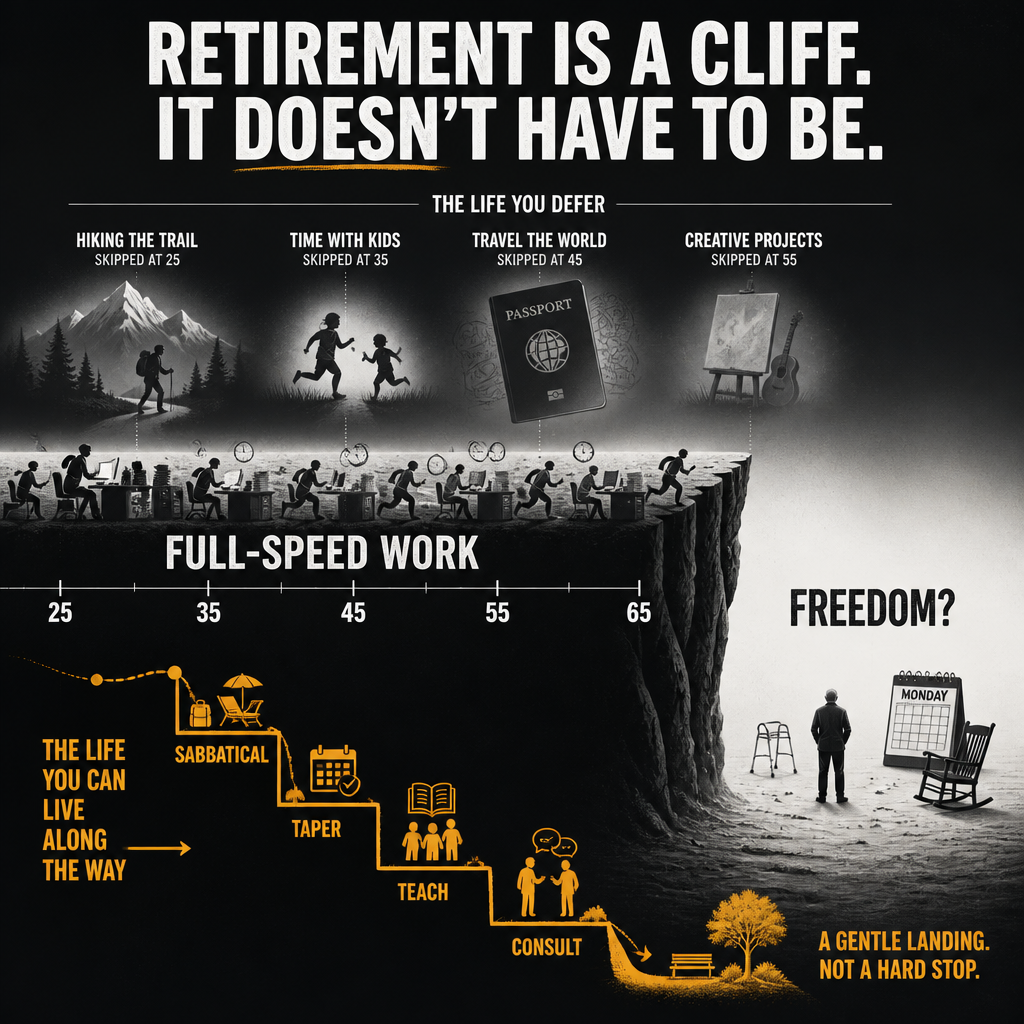
Retirement isn’t a scam because the accounts are rigged or the math is hard. It’s a scam because of the deal underneath it: trade the best four decades of your life for the promise of freedom at the end a promise that arrives late, degraded, or not at all.
The deferred-life bargain
The standard script goes like this: work hard from 25 to 65, postpone travel, passion projects, time with family, and rest — then cash in your accumulated freedom in one lump sum at the end.
Look at what you’re actually trading. You give up your years of peak health, peak energy, and peak curiosity. In exchange, you receive freedom during the years when your body is slowing, your risk tolerance is lower, and statistically, your remaining healthy years are fewer than you think. Healthspan and lifespan are not the same number. Many people get ten good years after 65. Some get two. Some get none.
No rational person would sign this contract if it were presented honestly: Pay now with your strongest decades. Collect later, maybe, in your weakest.
Why the model exists
The 40-year deferral wasn’t designed around human flourishing. It was designed around industrial labor. Bismarck’s Germany set the first retirement age at 70 when life expectancy was far lower; retirement was a brief pension for the few who outlived their usefulness to the factory. The American 65 came from the same logic.
We inherited a model built for assembly lines and applied it to knowledge work, where the assumptions don’t hold. A software architect at 65 isn’t “used up” the way a steelworker’s body was. Meanwhile, the things we defer travel, creative work, time with kids are exactly the things that degrade or disappear with deferral. Your children are only young once. Your knees only work for so long.
The cliff is bad for you even when you reach it
The model fails on its own terms. Retirement, as practiced, is an abrupt cliff: full-speed work on Friday, nothing on Monday. The research on what follows is sobering: loss of identity, loss of structure, loss of social connection. Rates of depression rise after retirement for a meaningful share of people. Some studies link early full retirement to faster cognitive decline. The reward at the end of the deferred-life plan can itself be a health hazard.
We spend decades sacrificing for a finish line that, when crossed, often makes people lonelier and sicker.
What the honest deal looks like
The alternative isn’t “never save” or “never stop working.” It’s refusing the deferral structure:
Buy freedom in installments, not a lump sum. Sabbaticals, mini-retirements, seasons of lighter work. Take some of your freedom at 35 and 45, when you can hike the trail and chase the kids, instead of banking all of it for 65.
Design work you don’t need to escape from. If the plan requires 40 years of endurance followed by escape, the problem is the work, not the absence of a beach. Autonomy, purpose, and pace are negotiable long before 65.
Plan for an off-ramp, not a cliff. Taper. Consult. Teach. Mentor. The people who age best rarely stop cold; they change gears.
Save aggressively anyway, but call it what it is. Money buys options at every age, not just the last one. The account isn’t the scam. The story about when you’re allowed to use your life is.
The real question
The financial industry will keep debating contribution limits and withdrawal rates. That’s the wrong layer. The question worth asking is simpler: why did we agree to a contract that prices our strongest decades at zero and pays out in our weakest?
You don’t have to opt out of saving. You have to opt out of deferring. Freedom isn’t a retirement benefit. It’s a resource you can spend all along, and the version you can spend at 40 is worth more than the version you’re promised at 70.
